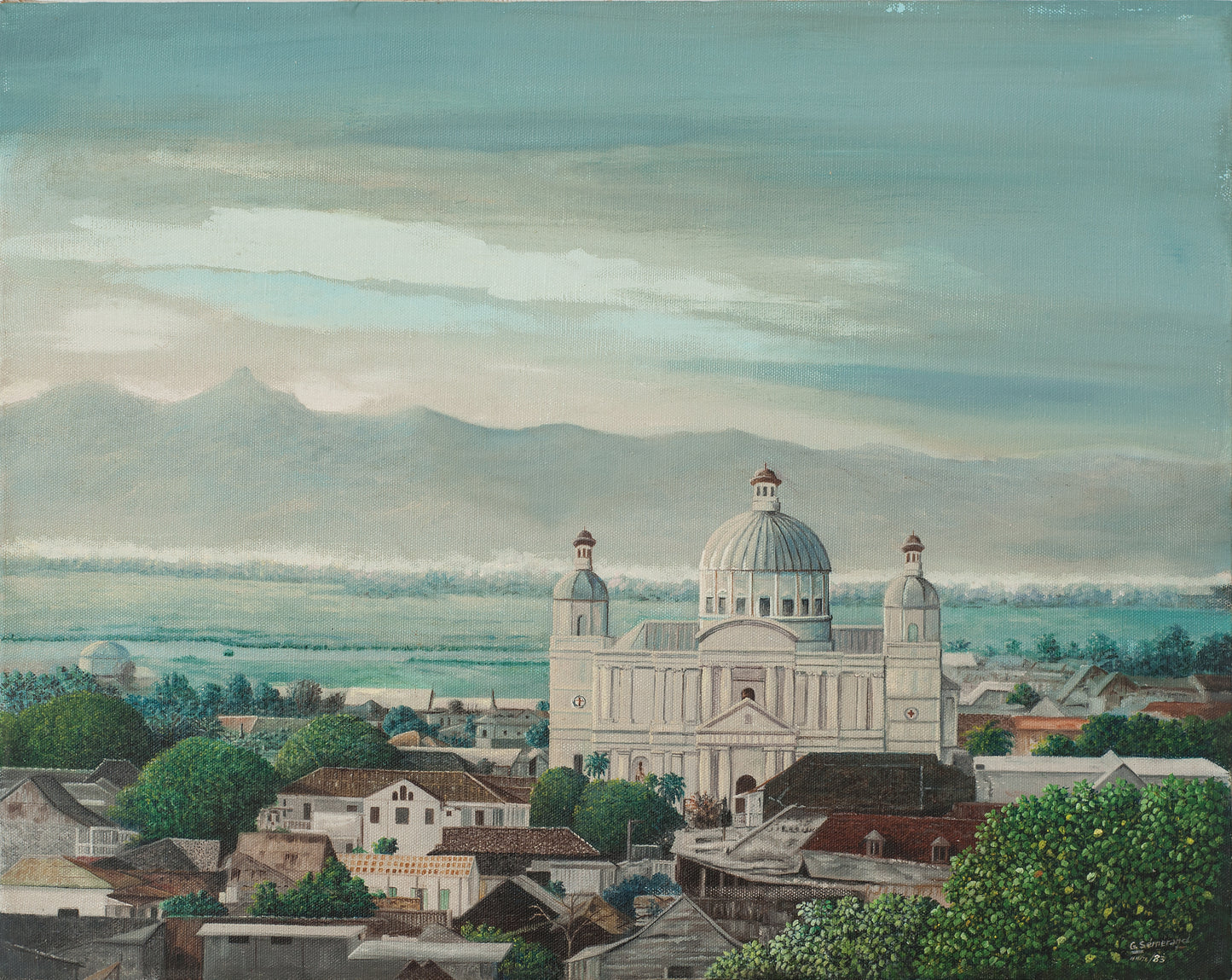
Galland Semerand (1953-2019) 16"x20" The Cathedral of Port-au-Prince 1983 Oil on Canvas Unframed Painting #18-3-95GN-HA-Family Collection of Marie & Georges S. Nader
Galland Semerand (1953-2019) 16"x20" The Cathedral of Port-au-Prince 1983 Oil on Canvas Unframed Painting #18-3-95GN-HA-Family Collection of Marie & Georges S. Nader
Couldn't load pickup availability
Description
Description
About this artist
About this artist
Galland Semerand was born in Cap-Haitian in 1953. He is from the Philome Obin workshop. " Semerand's use of detail is derived from the realism typical of artists from Le Cap, but his paintings also reflect a certain idealization" Gerald Alexis in his art book "Peintres Haitiens."
Gingerbread houses are an architectural style that originated in Haiti in the late 19th century. Gingerbread was coined by American tourists in the 1950s, who appreciated the style, which bore similarities to Victorian-era buildings in the United States. The movement of the type began in 1881 with the Haitian National Palace. In 1895, three young Haitians, Georges Baussan, Léon Mathon, and Joseph-Eugène Maximilien, traveled to Paris to study architecture and were inspired to build upon the nascent architectural movement and modified the style to the climate in Haiti by designing homes with vibrant patterns and dazzling colors to the French resort architecture.[1]
The gingerbread house by design combines architectural knowledge that stemmed abroad into understanding the Caribbean climate and its living conditions. They were constructed with tall doors, high ceilings, and steep turret roofs to redirect hot air above their inhabitable rooms, along with a cross-breeze of louvered shutter windows on all sides instead of glass to offset the most scorching of days. Flexible timber frames with the innate ability to weather some of the most brutal storms and tremors are built with wrap-around verandahs. The houses are usually constructed from wood, masonry, stone, and clay.[1][5]
This specific architectural heritage in Haiti is now seriously threatened as the natural aging of the wood, the weather, and the high cost of restoration and repairs are all slightly favorable to the survival of this monumental. The style has been nominated to the 2010 World Monuments Watch.[1] However, only five percent of the estimated 300,000 houses partially or fully collapsed due to the 2010 earthquake, compared to 40% of all other infrastructures that were considered to be in necessary condition, which leaves U.S. conservation experts to believe that this architecture can be a model for the seismic-resistant activity of the future. (Wikipedia). Guide To Prepare for Earthquakes
Own a piece of art by this artist? Each piece is unique. Get your actual estimated market value now! How Does It Work?
Want to know more about the beautiful art of Haiti? BUY NOW Your Haitian Art Book!
Need help finding what you are looking for? Click Here To Ask Us!