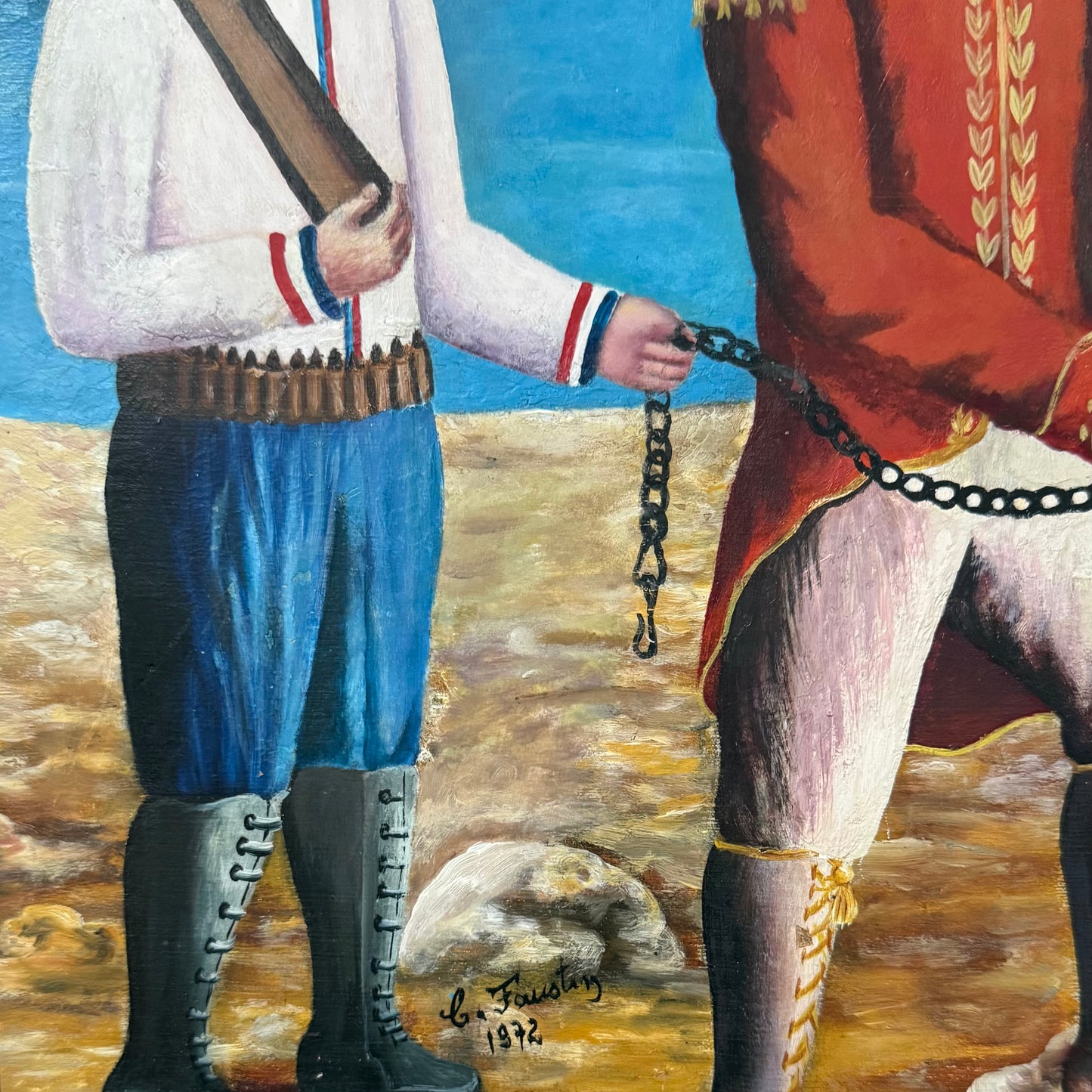
Celestin Faustin (Haitian, 1948-1981) 16"x24" Le Heros (Toussaint Louverture Deportation) 1972 Oil on Board Framed Painting #2MFN
Celestin Faustin (Haitian, 1948-1981) 16"x24" Le Heros (Toussaint Louverture Deportation) 1972 Oil on Board Framed Painting #2MFN
Regular price
$143,380.00
Regular price
Sale price
$143,380.00
Unit price
per
Shipping calculated at checkout.
Couldn't load pickup availability
Certificate of Authenticity Included
Description
Description
“Le Héros” by Célestin Faustin is a powerful Haitian historical painting depicting the deportation of Toussaint Louverture, one of the central heroes of the Haitian Revolution. The composition portrays Louverture in chains beside the sea as a military escort leads him toward the ship “Le Heros,” referencing the tragic events surrounding his capture and forced deportation by French forces.
Executed in Faustin’s distinctive narrative style, the painting combines historical symbolism, simplified forms, and emotional restraint to create a deeply evocative scene centered on sacrifice, resistance, and Haitian independence. The stark coastal setting and restrained palette heighten the emotional gravity of the moment while emphasizing Louverture’s dignity and heroic presence.
Célestin Faustin is recognized for his important contributions to Haitian historical and figurative painting, often exploring revolutionary memory and Haiti’s national identity through symbolic storytelling.
This original oil on board painting, created in 1972, is signed by the artist and accompanied by a Certificate of Authenticity issued by Myriam Nader Haitian Art Gallery.
About this artist
About this artist
Célestin Faustin (1948–1981) was a Haitian painter and Vodou priest recognized as one of the most visionary figures of modern Haitian art. He studied painting with Wilmino Domond and quickly developed a distinctive style that was haunting, poetic, and surreal. Faustin’s works often explore themes of personal anguish, spirituality, and the complex relationship between the visible world and Vodou cosmology. His paintings combine dreamlike imagery with dense figurative compositions, creating a powerful and deeply symbolic visual language. Art historian Gérald Alexis wrote in Peintres Haïtiens that “Faustin is too much of a virtuoso to be considered a ‘primitive’ painter, and his complex compositions, largely devoted to the divine, are an expression of his personal strategy.”Today, Célestin Faustin is regarded as one of the most original and influential voices in 20th-century Haitian painting.