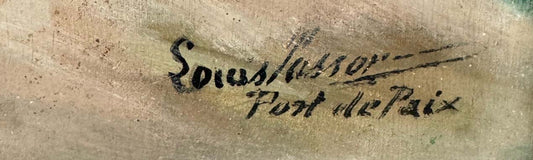
Collection: Louis Vassor (Haitian, 1888-1968)
Louis Vassor (December 20, 1888–August 15, 1968) was a Haitian painter, educator, and cultural figure born in Port-de-Paix. He began his classical studies in his hometown. He continued in Port-au-Prince at the Saint-Louis de Gonzague institution, where he received his first instruction in drawing and painting. The death of his father in 1902 forced him to return to the northwest of Haiti. Soon after settling in Saint-Louis-du-Nord, Vassor founded a small drawing and painting school offering free classes, collaborating with the painter Alfred Austin. Vassor was a keen observer of the major events shaping early twentieth-century Haiti. His work reflects an awareness of political resistance movements, including the struggle against foreign occupation and the epic of Charlemagne Péralte. In the 1920s, he was appointed photographer at the Haitian consulate in Santiago de Cuba, where he witnessed firsthand the large-scale migration of Haitian cane cutters. This experience deepened his social consciousness. Later, President Sténio Vincent appointed Vassor as director of the Port-au-Prince Learning Center, where he further developed his expertise in craftsmanship. He mastered frame weaving and various techniques using latanier leaves, integrating artisanal knowledge into his broader cultural practice. In 1946, he returned to Port-de-Paix and was appointed assistant inspector, then inspector, at the city’s labor office. During this period, he personally funded the creation of an adult education school and opened a painting school for young artists. Among those he trained were Clerveaux Auguste, Ambert Saint-Doux, Anthony Vassor, and his nephew. Louis Vassor’s work occupies a singular place in Haitian art history, bridging fine art, education, and social engagement. His paintings are considered rare on the art market, valued for both their historical significance and their role in shaping generations of Haitian artists. Scroll Down to Make Your Selection (s)!